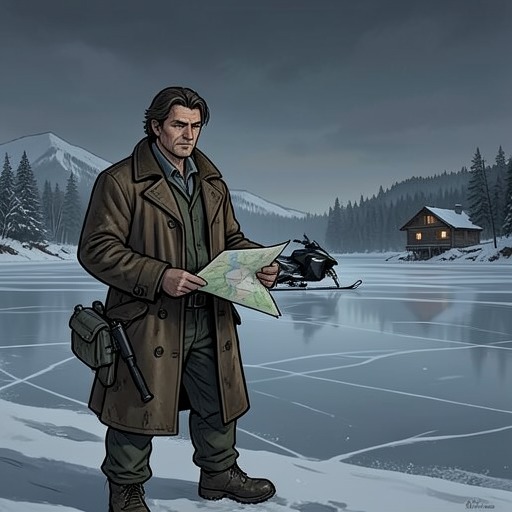
Mowat discovers the den and observes the wolf family
Never Cry WolfMowat discovers the den of a Barren Lands Wolf family at Wolf House Bay, turning a brief, uncertain encounter into the beginning of close observation. The discovery gives him access to the family’s home life, but it also unsettles the human story he had brought to the Arctic: the animals he expected to fearsome effect remain watchful without attacking him, even when he approaches their young. The encounter’s comic reversal, in which Mowat loses his footing and slides down the esker before three adults watch from above, helps shift his purpose from proving a theory to learning from what the animals actually do.
Finding the Den
The first clue appears when the female disappears into a shadowed fold of the esker. Looking through his glasses, Mowat realizes that the dark shape is an opening and that she has probably entered a den. Elated at having found both a pair of Barren Lands Wolves and a likely home site, he runs to a nearby knoll for a better view. The male immediately notices him and takes up a tense, vigilant position on the ridge. Mowat retreats rather than risk disturbing the family or forcing it to move.
The next morning he returns with a telescope and tripod, choosing a hidden observation point about four hundred yards from the den. Despite careful positioning and a search across the esker, he sees no sign of the animals. By noon, eye strain and cramps have replaced the excitement of the previous day. The den may, he worries, be no more than a convenient hole in the sand. The empty hours reveal a practical limit to his plans: in a vast, open landscape, sustained study depends on cooperation from animals that can remain out of sight.
The Pups and the Slide
Determined to examine the site, Mowat approaches the esker by canoe. On the way up its shifting sand he finds scat and well-worn tracks, evidence that the slope is a familiar route for the family. The den itself lies in a small hollow and is so concealed that he nearly walks past it. Small squeaks draw his attention to four gray pups playing below him. Their rounded bodies, short legs, and unfamiliar appearance initially make it difficult for him to recognize them as young wolves.
A pup catches his scent and pads toward him, stopping to scratch when a flea distracts it. Then an adult’s warning howl breaks the quiet. The pups dart into the den, and Mowat turns toward the adult, loses his footing, and slides down the loose slope. His rifle catches in the sand and is dragged free by its strap; entangled in equipment, he cannot draw his revolver. He goes past the den and down the esker, managing to stay upright through the descent.
At the end of the slide, he looks back to see three adult wolves lined up on the ridge, watching him. Mowat raises his sand-clogged rifle in frustration, but it will not fire. The adults do not withdraw until he begins waving the useless weapon and shouting at them; then they exchange looks and disappear from view. Rather than meet his intrusion with the attack he had anticipated, the family observes his undignified retreat. Mowat leaves too, shaken and embarrassed, and returns to Mike’s for comfort.
From Encounter to Observation
The episode weighs on Mowat after the immediate embarrassment has passed. In less than a week, he has repeatedly been vulnerable to the supposed savage killers, including when he has entered their home and appeared to threaten their pups. Yet their behavior has shown restraint. He recognizes that the accepted picture of wolf character may be false, while also confronting his own reluctance to abandon it: doing so would challenge received scientific ideas, remove the danger from his mission, and require him to accept that the animals have made him look foolish.
By the following morning, Mowat decides to approach the Barren Lands Wolves with an open mind and attend to their actual behavior rather than inherited descriptions of it. The discovery thus changes the terms of his investigation. The den is not merely a site to locate; it becomes a place from which to test assumptions against repeated observation. Later, he sees the family’s organization more clearly. The presence of a third adult initially puzzles him, until he comes to know this smaller, gray-overcast male as Uncle Albert. The family’s structure, including the adults’ involvement with the pups, complicates his first, simplistic picture of a mated pair and their young.
What the Den Makes Visible
Mowat’s method becomes more deliberate as the encounter develops into a vigil. He hides behind a rocky knoll, keeps the den in view through his telescope, and records observations in a wolf log. On a later morning, the leading male appears at 0814 hours and stops where Mowat has marked a boundary across the family’s trail. The wolf investigates a marked bush before looking toward Mowat’s tent. The small, carefully watched exchange makes the observer’s presence part of the scene: the animals are not only objects of study but also responsive neighbors with their own routines and boundaries.
The den also opens onto questions that extend beyond the family’s immediate behavior. With Ootek, Mowat listens for distant wolf calls; in another line of observation, he watches how hunting groups test deer and abandon pursuit when animals appear fit and able to escape. These later observations belong to the broader inquiry begun at the esker: replacing a fixed image of predatory danger with evidence gathered from particular animals, actions, and circumstances. The den discovery matters because it brings that inquiry close to home. A hidden hollow, four curious pups, a warning call, and three silent watchers begin the transition from a planned study of wolves to an account shaped by the wolves’ own conduct.